
Why Trying New Challenges Boosts Mental and Physical Health
A life with no challenge can feel safe, but it can also become strangely tiring. The body gets used to the same movements. The brain runs the same routes. Confidence shrinks around what feels familiar.
Trying something different, from learning to swim to joining a walking group, gives the mind and body fresh information to work with. It asks for attention, effort, patience and adaptation. That is why a well-chosen challenge can do more than fill a weekend. It can improve mood, build fitness, sharpen thinking and restore a sense of progress.
This article is for general information only and is not medical advice. Anyone with a health condition, injury or major mental health concern should speak to a qualified professional before starting a demanding new challenge.

New challenges give the brain a reason to adapt
The brain is not fixed. It changes in response to use, practice and experience. This ability is known as neuroplasticity, and it is one of the main reasons novelty matters.
When a person learns a new skill, the brain has to pay attention. It needs to notice mistakes, adjust movements, remember steps and make predictions. Over time, repeated practice strengthens useful pathways and prunes away what is less useful.
One of the best-known examples comes from research on London taxi drivers. Studies led by neuroscientist Eleanor Maguire found that experienced London taxi drivers had structural differences in the hippocampus, a brain area linked with spatial memory. The finding did not mean everyone should become a taxi driver. It showed something more useful: demanding navigation practice was linked with measurable differences in the brain.
Another often-cited study, published in Nature in 2004, looked at adults learning to juggle. Brain scans showed grey matter changes in areas related to visual motion processing after participants practised juggling. When they stopped practising, some of those changes reduced. In plain terms, the brain responded to learning, and continued practice mattered.
That is the point of a personal challenge. It creates the conditions for adaptation.
A challenge might involve:
Learning a musical instrument
Taking up climbing, yoga or swimming
Training for a 5K walk or run
Cooking a new style of food once a week
Learning basic phrases in another language
Trying a new class where coordination is required
The activity does not have to be dramatic. It has to be new enough to require attention and manageable enough to keep going.
Challenge builds confidence through evidence, not wishful thinking
Confidence often grows after action, not before it. When someone sets a challenge and keeps a promise to themselves, the brain receives proof: “I can do hard things.”
Psychologist Albert Bandura described this as self-efficacy, the belief that you can influence events and handle tasks. Research in this area has long shown that mastery experiences, meaning moments where people succeed through effort, are one of the strongest sources of self-belief.
This matters for mental health because low confidence can narrow life. A person may avoid social events, exercise, new hobbies or career steps because they expect failure or embarrassment. Small challenges interrupt that pattern.
The challenge must be the right size. Running a marathon with no training is not confidence-building. Walking briskly for 20 minutes three times this week, if that is new, may be.
A useful challenge sits in the middle:
Too easy | Useful challenge | Too hard |
Requires little focus | Requires effort and practice | Creates panic or pain |
Keeps you comfortable | Feels uncertain but possible | Feels unsafe or unrealistic |
Gives little feedback | Shows clear progress | Leads to quitting or injury |
This “stretch zone” is where growth tends to happen. It is also where many people rediscover enjoyment. Progress feels good because it is earned.
Physical challenges improve health in clear, measurable ways
Physical challenges bring an obvious benefit: they make the body move. That can improve cardiovascular fitness, strength, balance, mobility and energy.
The UK’s NHS guidance reflects World Health Organization advice that adults should aim for at least 150 minutes of moderate intensity activity each week, or 75 minutes of vigorous activity, plus strengthening activities on two days. Many people do not need a gym to reach this. Walking uphill, cycling, dancing, swimming, carrying shopping, gardening and bodyweight exercises can all count when done with enough effort.
The research picture is strong. Large population studies consistently link regular physical activity with lower risk of premature death, heart disease, type 2 diabetes and some cancers. Exercise also supports bone health, balance and muscle strength, which become more important with age.
A challenge can make this advice easier to follow because it gives activity a purpose. “Move more” is vague. “Walk 30 miles this month” is clear. “Get fit” is hard to measure. “Do ten press-ups with good form by the end of eight weeks” gives the body a specific target.
Physical challenges work best when they are progressive. The body adapts to stress, then needs a little more to keep improving. This principle applies whether the goal is strength, stamina or flexibility.
For example:
A walking challenge might start with 15 minutes and add five minutes each week.
A strength challenge might begin with wall press-ups, then move to knee press-ups.
A cycling challenge might increase distance before increasing speed.
A mobility challenge might focus on daily hip and shoulder movements.
The aim is not punishment. The aim is gradual adaptation.
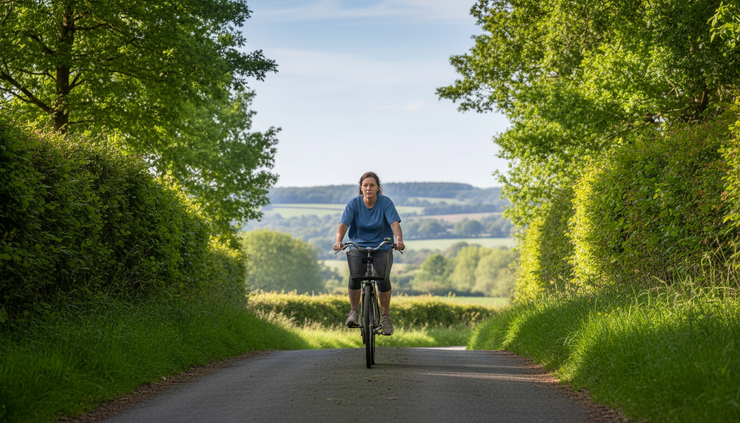
Exercise challenges can lift mood and reduce stress
The link between exercise and mental health is supported by a large body of evidence. Physical activity is not a cure-all, and it should not replace proper treatment for mental illness, but it can be a powerful support.
A 2018 study in The Lancet Psychiatry analysed data from more than 1.2 million adults in the United States. People who exercised reported fewer days of poor mental health in the past month than those who did not. The study was observational, so it could not prove that exercise caused the difference, but the association was strong across many types of activity.
A large 2023 umbrella review in the British Journal of Sports Medicine also found that physical activity helped reduce symptoms of depression, anxiety and psychological distress across a wide range of adult populations. Some of the strongest benefits were seen with moderate to high intensity activity, though even gentler movement can help people who are starting from a low base.
Why does it help?
Exercise affects the body and brain in several ways:
It can improve sleep quality, which supports mood and concentration.
It increases blood flow to the brain.
It can reduce muscle tension linked with stress.
It gives the mind a break from rumination.
It offers a sense of achievement after effort.
Challenges add another layer. They create structure. A person is no longer exercising only because they “should”. They are training for a walk, learning a dance routine, improving their swim stroke or preparing for a charity event.
That purpose can be motivating on difficult days.
Novelty helps break the stress loop
Stress often feeds on repetition. The same worries, the same environment and the same habits can make life feel smaller. Trying something different interrupts that loop.
Novel experiences demand attention. That shift can pull the mind away from repetitive worry and into the present moment. This is one reason activities like climbing, wild walking, dancing, pottery, archery and paddleboarding can feel mentally refreshing. They require the person to notice what is happening right now.
There is also a biological idea known as hormesis. It describes how a manageable dose of stress can make a system stronger. Physical training is a simple example. A workout stresses muscles and the cardiovascular system. With rest, the body adapts.
Mental challenges can work in a similar way when they are chosen carefully. Speaking up in a group, attending a class alone or learning a skill in public may feel uncomfortable at first. Repeated safe exposure can reduce fear and increase tolerance.
The key word is manageable. A good challenge should not flood the nervous system. If it creates lasting panic, shame or exhaustion, it is too much for now. Reduce the size until it becomes possible.
Learning new skills supports ageing and cognitive health
Cognitive health is not only about puzzles and memory games. Real-world learning may be especially useful because it combines attention, problem-solving, physical coordination and emotional engagement.
Research on ageing often points to the value of cognitive stimulation, social connection and physical activity. A challenge can combine all three. Think of joining a choir, learning ballroom dancing, taking up tennis, practising a language or going on guided nature walks.
Dancing is a good example. It involves rhythm, memory, balance, coordination and often social contact. Studies have linked dance programmes with improvements in balance, mobility and aspects of cognition in older adults, although results vary depending on the type and length of the programme.
Skill learning also protects against the quiet loss of identity that can come with routine. People need to feel they are still becoming, not only maintaining.
That matters at every age.
A teenager learning to cook gains independence. A parent taking up running may gain a private sense of strength. A retired person joining a walking football group may gain fitness, friendship and weekly structure.
The health benefit is not only in the activity. It is in the message the activity sends: growth is still available.

Social challenges can strengthen connection
Many challenges become easier, safer and more enjoyable with other people. Joining a beginner group, walking with a friend or signing up for a community event adds accountability. It also gives the challenge a social reward.
Social connection is strongly linked with health. The long-running Harvard Study of Adult Development, which has followed participants for decades, is often cited for one clear finding: close relationships are deeply connected with wellbeing and healthy ageing. The study cannot reduce health to friendship alone, but it highlights how much relationships matter.
Challenges create natural ways to connect without forcing small talk. People can talk about the route, the recipe, the class, the weather, the shared nerves or the progress they have made. That can be especially helpful for anyone who finds purely social events difficult.
Good social challenges include:
Joining a weekly walking group
Taking a beginner climbing or swimming course
Signing up for parkrun as a walker, runner or volunteer
Starting a shared step challenge with friends
Joining a community gardening project
Learning a craft in a small group
The goal is not to become highly social overnight. The goal is to create repeated, low-pressure contact around something active or interesting.
The best challenges are specific, flexible and kind
A challenge should create momentum, not guilt. The best ones are clear enough to guide behaviour but flexible enough to survive real life.
A vague aim sounds like this:
“I want to get healthier.”
A stronger challenge sounds like this:
“I will walk for 25 minutes after lunch on Monday, Wednesday and Saturday for the next four weeks.”
That version works because it says what, when and for how long. It also allows review. At the end of four weeks, progress is visible.
Behaviour research supports this kind of structure. A study by Phillippa Lally and colleagues, published in the European Journal of Social Psychology, found that habit formation took 66 days on average, with a wide range between people and behaviours. The useful lesson is simple: habits take time, and missing one day does not ruin the process.
Try this framework for a healthier challenge:
Choose one area
Pick physical fitness, confidence, creativity, social connection or learning. One focus is easier to sustain than five.
Make it measurable
Use minutes, sessions, distance, repetitions, recipes, pages, lessons or practice days.
Start below your limit
The first week should feel almost too easy. This reduces injury risk and helps build consistency.
Add progress slowly
Increase time, intensity or difficulty in small steps.
Plan for obstacles
Decide what you will do if it rains, if work runs late or if motivation drops.
Track effort, not perfection
A tick on a calendar can be enough. The point is to see evidence of showing up.
Review after a set period
Four to eight weeks is long enough to notice change without feeling endless.
Challenge should include recovery
A challenge is good for health when it includes rest. Without recovery, effort becomes strain.
Muscles need time to repair. The nervous system needs quieter periods. Sleep supports memory, mood, immune function and learning. A person who trains hard but sleeps badly may not get the full benefit of the work.
Signs that a challenge may be too intense include:
Persistent pain
Worsening sleep
Irritability or low mood
Loss of interest in the activity
Feeling anxious before every session
Needing more and more effort to get the same result
Scaling back is not failure. It is part of intelligent training.
For mental challenges, recovery might mean taking breaks between social events, practising a skill privately before a class or choosing a smaller version of the task. For physical challenges, it might mean rest days, easier sessions, stretching, good food and enough sleep.
The healthiest challenges build capacity over time. They do not demand constant intensity.

Small challenges can change the way life feels
Trying something different does not need to transform every part of life to be worthwhile. A good challenge creates a small proof of possibility.
The first swim lesson may reduce fear. The first hill walk may reveal more stamina than expected. The first pottery class may bring back a sense of play. The first month of strength exercises may make stairs feel easier.
These changes matter because they are both mental and physical. The body gains skill, strength or endurance. The mind gains evidence, confidence and flexibility.
Start with one challenge that feels slightly uncomfortable but safe. Give it four weeks. Track what changes in your mood, sleep, energy, confidence and body. Keep the goal small enough to repeat and meaningful enough to care about.
Health is not built only in clinics, gyms or grand life plans. It is also built in the moment someone says yes to a new path, practises again after a poor attempt and discovers that effort can make life feel wider.


Comments